~ notes from an uncommon journey ~

How Rachel Held Evans Helped Me Lose My Faith—And Why I Think She'd be OK With It

With Rachel at Ohio Wesleyan University on November 7, 2014.
  
I still remember how I heard the news, one year ago today: I was sitting up in bed after sleeping in on a Saturday morning and scrolling through Facebook on my phone...when I saw the news that made me gasp in disbelief.


I had heard she had taken ill, that she'd been hospitalized, that she was in fact in a coma. But I remember not having been too concerned. I'm sure I assumed she would pull through. We never think it's going to happen to the people we care about. 

What I don't remember (as I wrote in 2013) is exactly how I first discovered Rachel (though I suspect it was Twitter). But as I read her first two books, Evolving in Monkey Town (now sold as Faith Unraveled) and A Year of Biblical Womanhood, and her blog, her voice became a welcome influence on my thinkig

She was a believer...who also had doubts, and wasn't afraid to express them. (Or if she was afraid, she shared them anyway.) She tackled tough Bible passages and tough issues. She called out the evangelical church on its bullshit. She cared about social justice and actively used her platform and influence to lift up the voices of the marginalized. And she did it all with such grace and humor. I believe the word "winsome" applies.

When she gave voice to her doubts, she was, without knowing it, also giving voice to mine. She made her blog a safe place to share those doubts, and she never once responded to me judgmentally. And I came to learn firsthand that she treated those whose doubts led them to different places than hers had...as kindred spirits, even. In fact, when I met her in person for the first time, she acted like we were already legit, IRL friends. She could not have been nicer to me. (And later, when I tweeted a link to the post I'd written about meeting her, she not only retweeted it, she also included in her next "Sunday Superlatives" post a sweet word about meeting me, a link to that post, and the photo we'd taken together. Incidentally, her sharing links to my post led to its views skyrocketing; it remains my most-viewed post of all time by far.)

And during the second—and as it turned out, final—time we met (photo above), we got to spend a little time together, just the two of us. And when I told her that I'd become agnostic, she didn't flinch or judge me or try to pressure me to change. She simply continued treating me like a friend.

In the years between that meeting and her passing, I got to the place where I wasn't really seeking out Christian content anymore (and Rachel's work wasn't any exception). I had largely moved on. But I still valued her voice and how she was continuing to use it. 

After she passed, I read many articles about her and about her death—straightforward news pieces, obituaries, and some of the numerous tributes posted by friends and fans alike. I read quite a bit of the #BecauseOfRHE hashtag. And I was surprised that among all of that I found not one mention of how, in addition to helping many people retain or return to their faith, she helped others eventually leave faith altogether and become OK with it, to become OK with, in my case, uncertainty.

And while my life is far from perfect, I am so glad to be free of religion, to have a vastly different—and more benevolent—view of the world than I did before. I believe there's a higher power, but I don't know what form it takes or what it looks like. And I no longer think it matters if I get it "right." Nor do I believe any longer that I'll be punished if I don't.

And, as it turns out, I am not alone. 

From Missy Hunsberger, "She gave me permission....":
  • "This book [A Year of Biblical Womanhood] gave me permission to see the Bible in a different light...."
  • "She gave me permission to be angry. To be bold. To express that anger."
  • "She gave me permission to be proud of my vote for Hilary Clinton... all I can think about when I see that picture being shared of her everywhere, is that this was the picture she posted when she wrote about all the reasons why she voted for Clinton and not Trump. There was a time I believed you couldn't vote Democrat AND be a Christian. She helped me see past that." [links mine]
  • "She gave me permission to be angry at the church and to take some [time] away if that's what I needed. She made me feel like I wasn't alone."
  • "Perhaps most importantly, she gave me permission to believe that being gay was okay. I was largely there, but she gave me permission to go all the way, even before I knew my own queerness."
  • In Faith Unraveled, "She spoke the words to so many of my questions in this book. I don't even know if she answered any of them, but the importance of someone writing down and also wrestling with these same questions was invaluable to me. She gave me permission to question."
  • "She also gave me permission to walk away. She didn't shame me, question me, and she wasn't concerned for my soul. She trusted my journey, my hurt, my disbelief and she understood.

Rachel was a lifeline.... As I delved into her work I was so hesitant because I had been warned about the likes of her. About the slippery slope I was about to go down if I listened to her. I heard all about the dangers of too much love and too much grace.... I didn’t think I would have the audacity to take such a leap [leaving church], but reading Searching for Sunday: Loving, Leaving, and Finding the Church that Spring gave us the push we needed to leave by Summer. It’s been three years since we left that world behind and we haven’t looked back.... The last part of the subtitle in Searching for Sunday reads Finding the Church. I don’t know if that will ever happen for us. If it does, I know it will be because Rachel laid the groundwork by leaving guideposts along the way of what is possible when the toxicity of evangelicalism is removed from the equation. She left behind hope that those of us who feel hopeless don’t have to wait for the religious establishment to offer us a seat at the table. We can offer it to each other here– now.


And from my friend Ashleigh Miller:

I can’t tell you the exact moment I found her; all I can tell you is that her life and blog changed my life. I have always seemed to live in the in between. Rachel was the first person I encountered that seemed to do the same. Her blog and the community she created gave me hope.

 Growing up in a conservative Mennonite community, questions were not encouraged from anyone and much less so from women. I always had them. When I found her blog, I remember thinking, "You mean other people think these things, have these questions?" The peace that came with that was incredible. Later in my deconstruction, she helped me to feel so sure that the god I was raised to believe in was not who god is. I remember an epiphany I had that year: I admitted that if that god did exist, I didn’t want to spend eternity with him.
 
Meeting her and hearing her speak was one of the great privileges of my life. I got this opportunity on three separate occasions, the last of which was at the very first Evolving Faith Conference. The blessing of seeing her preach boldly with a baby on her hip is something I will always cherish. This was also the place where she gave me permission to admit that I was no longer a Christian. I remember walking up to take communion, knowing that it was my last, at least for now. The inclusion she strove for was so incredible and inspiring and it gave someone like me so much hope and joy, even as I grieved for the things I was letting go of. The things I no longer needed.

The day I heard she had died, I wept. The world lost someone so important, and there would be no one else like her. I lost someone so impactful to my journey and my deconstruction. Dan lost his partner. But mostly I grieved for her babies. These two beautiful littles that now had to grow up without their momma. The trauma I knew too well that touched their lives. It was May 4th when she passed on; it was May 12th twenty-four years before that my papa passed, when I was five. This loss for her babies brought my own loss more to my mind than it had in some time. I’m so glad that they have access to things I never did. So many tangible ways to remember her, so many people to share her legacy. So today I do grieve for my loss, for the world's loss, but especially her family's and those babies' loss.

 Rachel, thank you for all you are and all you gave to the world; thank you for all you gave to me. I wish so much you could be with your littles. You are a woman of valor. May the Fourth be with you. Blessed Be.


Rachel: You will always have a place as a major signpost along my journey. I'm not sure if I ever told you this. So I'm telling you now: Thank you. I don't know if I'd be where I am without you. You are and will continue to be sorely missed.
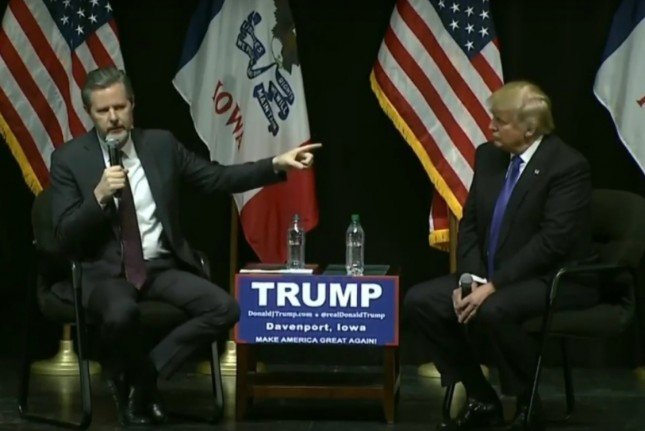
Evangelicals: I SEE YOU, AND I SEE YOUR HYPOCRISY. I SEE IT.

Source: theblaze.com.

So Jerry Fallwell, Jr. (president of Liberty University), one of evangelicalism's first and most enthusiastic endorsers of Donald Trump, was interviewed on NPR on Thursday.

INSKEEP: What have you heard from other evangelical leaders about supporting Donald Trump so early and so strongly? 
FALWELL, JR.: You know, it was funny that rank-and-file evangelicals were ahead of all the leadership.

Great
. If that's true, it's way, way worse than I than I'd thought.


[FALWELL, JR., cont.]: They saw for decades conservative Republicans had made promises to them on issues that were important to Christians and conservatives when they were running for office. But when they won, they didn't keep those promises.

When did you ever think they were going to keep their promises to you? When did you ever think that making this country "more Christian" was really at the top of their priority lists? Oh wait—for a long time, I know. So I guess the better question is: Why? WHY did you ever think that?!?

And wait—wasn't Jesus always having to remind people that His is a spiritual kingdom and not about the politics of the day?

John 18:36: Jesus said, “My kingdom is not of this world. If it were, my servants would fight to prevent my arrest by the Jewish leaders. But now my kingdom is from another place.”

 Also, the phrase "kingdom of God" appears 54 times and "kingdom of heaven" 31 times in the Gospels alone (of the New International Version).

So...maybe—I'm just going out on a limb here—maybe Christians shouldn't trust political leaders to make this country more like, say, themselves...and should instead focus on the spiritual kingdom, perhaps by fulfilling the first and second greatest commandments, the ones on which all "the law and the prophets" hang? Just a thought.

For anyone listening in who may not be familiar enough with the Bible to know, here are the two greatest commandments:

“Love the Lord your God with all your heart and with all your soul and with all your mind.” This is the first and greatest commandment. And the second is like it: “Love your neighbor as yourself.” All the Law and the Prophets hang on these two commandments.” (from Matthew 22:3740)

 Love God and love your neighbor. That's it. And in case anyone wondered who his or her neighbor was (so they could get away with making certain people not their neighbor), Jesus told an entire parable to clear up that one.


[FALWELL, JR., cont.]: And I think, you know, like the song by The Who "Won't Get Fooled Again," I think they just decided no more. We want somebody who maybe makes mistakes and maybe sort of talks off the cuff and may not get it right all the time, but at least he's not bamboozling us.

 Noooo, Trump's not bamboozling you at all. Not even one tiny little bit.


INSKEEP: Is his personal life or any candidate's personal life relevant to you?
FALWELL, JR.: Well, I think Jesus said we're all sinners. When they ask that question, I always talk about the story of the woman at the well who had had five husbands and she was living with somebody she wasn't married to, and they wanted to stone her. And Jesus said he's - he who is without sin cast the first stone. 

Um...No. If you're going to use stories from the Bible—the book you supposedly believe to be the most sacred of all—and if you're going to use them on a national program, and if you're going to use them to, of all things, justify your support of probably the most unChristian* presidential candidate in American history...at least get those stories right.

There was a woman at the well. And she had had 5 husbands. But a) no one wanted to stone her, b) Jesus talked to her about spiritual stuff—He didn't try to get her elected to public office (there's a ginormous, important difference), and c) Jesus talked to her even though she was both a woman and part of an outcast ethnic group. (Think about it.)

The one about whom Jesus said, "he who is without sin cast the first stone" was the woman caught in the act of adultery, for which a bunch of religious establishment dudes wanted to stone her to death. And...oh yeah, she was, like, a totally separate person.


[FALWELL, JR., cont.]: I just see how Donald Trump treats other people, and I'm impressed by that.

Oh, so you’re impressed by a man who disrespects women, mocks the disabled, and stereotypes people based on country and religion (rather than, say, welcomes the stranger as the Bible says to do)? (And those were just the examples that sprung to mind. We both know there are more.)


Wow. Just...Wow.

* * *

If Trump has done anything "for" us, it may be that he revealed the true nature of many evangelicals (and a lot of other people in this country). As Jonathan Merritt put it in an excellent piece for The Atlantic (emphasis mine):

Evangelicals are acutely aware of their waning cultural influence and shrinking share of the population. These religious leaders care about their principles, yes. But they care about something else even more: power. While not every evangelical leader is enthusiastic about Trump, many are starting to express warm feelings toward the candidate.

 I really believe that rather than causing misogyny, racism, homophobia, and xenophobia among his supporters, he has merely exposed it. He has somehow "given people permission" to bring all that ugliness out into the open. As bothered as I am by Trump, I'm bothered even more by the fact that he has supporters—and enough to have actually won presidential nomination.

* * *

Back to Jerry. Does he represent all evangelicals? Certainly not. (He doesn't even completely align [politically] with his own brother, who happens to be the pastor of their late father's church.)

But he represents a lot of them. Trump met with 1,000 or more evangelical leaders last month, and he received plenty of praise from them, as well as endorsements from many who once vehemently opposed him. (Source: Merritt's piece, linked above.)

So—I am speaking here to Jerry and to those evangelicals he does represent:

Dudes, your hypocrisy has finally come out.

There had to be at least a strain of this hypocrisy there all along if this—THIS—was ever going to be a result.

Are you proud of yourselves?

Because I'm pretty sure that Jesus is not.

——————————————————————

*I've got a newsflash for ya: Being a Christian is not required to be a good president. It's not even required to be president at all. It's possible for a person of another faith or even—gasp!—of no faith to be principled enough, to have all of the right qualities, and to make an excellent president. It really, really is.

P.S. The title of this post is paraphrased from Jon Stewart's epic, not-to-be-missed takedown of hypocritical conservative media and Republicans.

10 Things in 10 Years

September 4 was the 10th anniversary of Ron's death. Earlier this year, for International Widows Day (held annually on June 23), Soaring Spirits International asked members of its community to submit a story of something they'd accomplished post-loss that they were proud of or had never thought they'd do. And on that day, Soaring Spirits periodically shared these stories on its Facebook page as a way to celebrate widows' amazing spirits and to inspire others.

My first thought on hearing about this (and the only one for quite a while) was, "I haven't done ANYthing yet that I didn't think I'd do!" Only after pondering for a while did I realize a couple of things that did, in fact, fit that description. And in the meantime, I've thought of several other things that do as well. Why didn't I think of any of these things right off the bat? I think it's because my list of "want to's" in life is so long, and I haven't had the energy to do so many of them, that that's the first thing I think when I encounter this question. I guess in the future I'll just have to try to remember the following list. And now, without further ado, here are 10 things I've done in 10 years that, if you'd told me right after Ron's death that I'd do them, I'd never have believed you:
  1. Survive.
    Seriously, when the person you love most in the world dies, you think you're going to die, too. At least you want to. And you have to decide, moment by moment until you can do it hour by hour until you can do it day by day, that you're not going to join your beloved on the other side. Even though the only thing you wanted and still want is to be with that person. Thanks for my not doing that go in largest part to the grief support resources I discovered early on: a grief support website (no longer in existence) with a 24/7 chat room—a life saver!—and no less than 3 separate in-person support groups. For online support now, I go to Facebook groups and Widowed Village (which also has a 24/7 chat room).
  2. Date again.
    After Ron died, my thinking was: I've already had the love of my life; why would I want to do that or try for that again? What I didn't know yet was: that was just the grief talking. About 9 months after Ron's death, I met Tim....and sensed a connection with him from our very first conversation. Within a couple weeks, we were dating. I think it took that experience to show me, as nothing else probably could have, that I did in fact want to and could love again. He and I didn't last, and I haven't yet found a truly long-term relationship, but at least I know it's a possibility.
  3. At Camp Widow West 2013 (source).
    Shirt from the American Widow Project.
    Call myself a widow.
    When he died, Ron was my "boyfriend." We'd just started dating officially a couple months before. But I realized pretty quickly that "boyfriend" didn't begin to cover what he meant to me. "Dating" wasn't nearly sufficient. I began to call him my fiancé because we had talked so much about getting married; we had agreed in our hearts that we were headed for it. I truly believed that I would marry him someday. Even more than all that, though, the thing that most gave me permission to call myself "widow" was the essay The Widow's Gates by Kim Go. It opened my eyes to the historically-wider meaning of the word "widow" and more importantly, validated my unique journey. I can never thank Kim, herself a widow who was wedded, enough for writing that piece.
  4. All of us at my first Camp Widow. Can you see me? (source)
    Find and join an inclusive community through something called Camp WidowI can't remember exactly how I first heard about Camp Widow or its parent organization, Soaring Spirits (though I've racked my brain trying to!). But I'm so very glad I did. The thing that makes Soaring Spirits so meaningful to me is that anyone whose significant other died is welcome to participate in its programs—regardless of marital status, gender, age, or orientation. Of course, if it weren't so inclusive, I wouldn't be a part of it. I've been told time and again that I'm "not really a widow" because Ron and I weren't married. But that distinction doesn't matter at Soaring Spirits. The other thing that makes it so meaningful to me are the many friendships I've made through it, including some that I now hold dearest.

  5. Support other widows. If I didn't imagine calling myself a widow, I certainly couldn't have imagined supporting other widows. But in July 2010, I and one other UW started the Unwedded Widows Facebook page (for UWs and supporters), and a few years later, I added the Unwedded Widows group (for UWs only).

    In 2013, Soaring Spirits started their Regional Group program, which allows widowed people in the areas where there are groups to regularly hang out with others who "get it." And I volunteered to lead Soaring Spirits Central Ohio, which has been in existence since August of that year.

    I've gotten indications that these support avenues have been helpful for people, and I am so, so grateful that's the case.
    With some of the members of SSCO.

  6. Start 2 blogs.
    Of course, in 2004, I probably would've said, "What's a blog?" But about 5 years after Ron died, I started my other blog, Loving From the Inside Out—part of my attempt to bring good into the world out of his passing. There's still a lot more I want to do around that concept...and I'll certainly share about it when I do.
  7. With Bare Escentuals Executive Chairman Leslie Blodgett during
    her visit to our store in July, 2010 (source / credit: Photolosophys).
    Become a makeup artist.
    In June 2007, I was laid off from my full-time job as a technical communicator, the job I had when Ron died. And while being laid off was certainly no fun, if it hadn't been for that, I'd never have needed a second job to supplement the temping I was doing, and I'd never have applied at Bare Escentuals. I already used and loved the foundation and a few other products, and I thought it'd be cool to work there. And it was. But it was more than that. For the first time, I really learned how to apply makeup, something I'd never been taught growing up in a home where it was largely forbidden. And knowing how to skillfully apply makeup helped me feel more beautiful and helped me help others to do the same. And not incidentally, that job did even more for me: it provided a bright spot in my life. It helped me experience some much-needed cheerfulness and fun. It gave me something to look forward to, which I hadn't had in a long time. I will forever be grateful for my time at BE.
  8. Take long, solo car trips.
    In 2012, I wanted to go to Camp Widow East, but flying to Myrtle Beach (where East was held for the first 2 years) was so expensive, I knew I could rent a car and drive there for cheaper than the flight. And so I did, even though I couldn't find anyone to ride with me. And then in September 2013, I drove to New Jersey and back during a weekend so I could spend more time with my widowed peeps. As I've said before, it's certainly not the solo part that I love; I just don't let that part stop me. And I gained in confidence through doing it! Always a good thing.
  9. Become a LGBT ally.
    Having grown up Independent Fundamental Baptist, there was only "one" answer regarding all things LGBT, which of course was that all of it is wrong, period. I mean, it's clearly stated
    Card given to those who sign up to be allies to the Pride
    Partnership (employee group) at my company. This now
    hangs directly below my nameplate outside my cubicle.
    in the Bible, right? Well, thanks largely to my frequent readership of Rachel Held Evans' blog and other voices, I have come to have a very different opinion about that. Especially since many scholars believe that the passages that conservatives interpret as being anti-homosexuality are actually referring to pedophilia and similar forms of abuse. Also, this video was especially enlightening. But possibly the biggest thing that shifted my thinking? The simple question: When did I decide to be straight? Ohhh, right. I didn't. Plus: I don't care anymore how other people live. 'Long as they're not causing harm to self or others,...I couldn't care less. Anyway, I'm so grateful I've changed in this way. There are people in my life today who I've come to care a great deal about who wouldn't be, if I hadn't changed my mind and heart.
  10. Take up yoga.
    Well, yoga was another thing forbidden by the IFB. The conservative Christian "party line," as I've heard it, is that yoga comes out of Hinduism and is therefore evil and that you're a) worshiping Hindu gods when you assume certain poses and b) inviting demons into your body and life when you sound an "om." I've even heard that "om" is the name of a specific demon. (How anybody would even "know" that, I have no idea.) Well, I now find all of that to be patently ridiculous. Worshiping is an act of the will; it's not like you can accidentally worship something. And as for "om"? A very experienced yoga teacher, when I asked what the deal with "om" was, said that the word itself doesn't mean anything; sounding it is just a way to experience vibration in the belly, chest, and head. I started practicing in June of this year, and I've come to love going to class. I've begun to see inklings of a difference it is making in my life, and that is very cool.

 And...a bonus one (since this one didn't occur until just after the 10-year mark passed): Have my own website. I don't remember when I first had the idea of having my own site, but it may've been because my old Internet service provider included some free website space with every account. I'd learned a little HTML in my work as a technical communicator, so I created one on that platform, but it was pretty rudimentary. It did, however, tell the story of Ron and me. Later, when I changed ISPs, that site went away. Then sometime within the last couple years, I discovered Wix, which allows people to create their own professional looking site without having to do any coding. And after a lot of thought and hard work, I finally have a site that I'm proud of and that once again tells my and Ron's story. Ladies and gentlemen, I give you...conniewinch.com:


So there you have it. Come to think of it,...I've done a lot! 

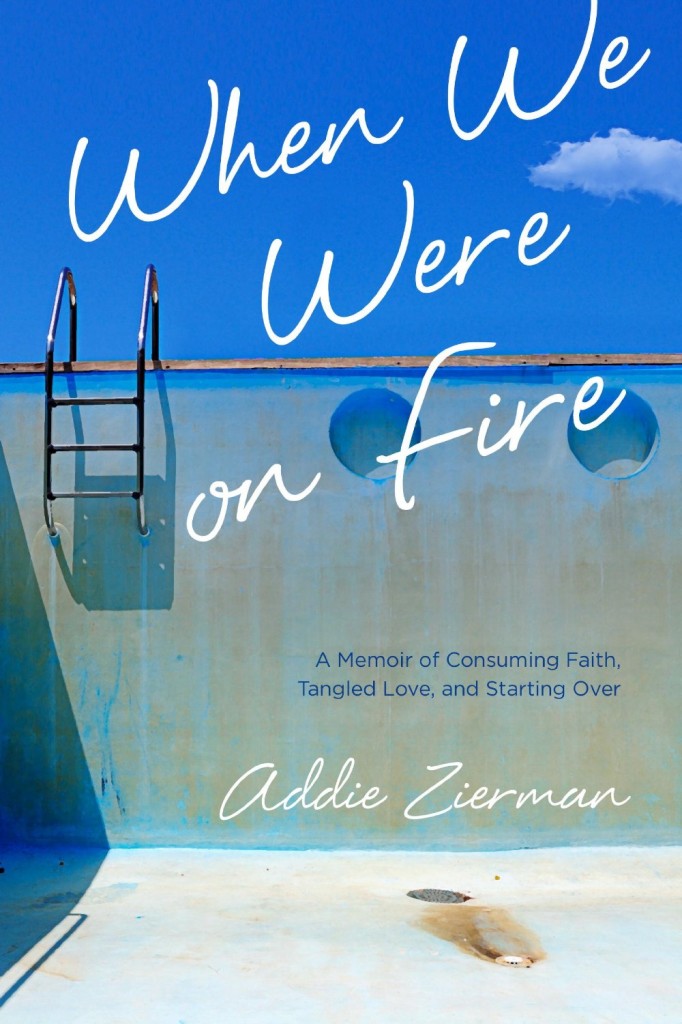
Review: When We Were on Fire


Addie Zierman is another one of those people/online friends/writers that I don't remember exactly when or how I first discovered. But when I did, I loved the name of her blog, How to Talk Evangelical (which reminded me of this book); it has had a place on my list of Favorite Blogs: Christian Faith & Doubt since I debuted this design. And I loved even more its "thing"--on it, she reexamines her faith, one evangelical cliché at a time. Because...yes. Evangelicalism certainly has its clichés. (Perhaps that's like all traditions. Maybe it's even unavoidable.) But oh, the damage that has been done by so many of those clichés. :sigh:

Anyway, we have a lot in common, Addie and me. We've both lived significant portions of our lives in the Minneapolis, Minnesota area--I, my first 20 years; she, her college years and now. We both left home for a far-away evangelical college--she left Illinois for Northwestern College (now University of Northwestern) in St. Paul, and I left Minnesota for Cedarville College (now Cedarville University) in Ohio. We both ended up living long-term near where we went to school. We've both been technical writers, creating user manuals for computer software companies. We both loved Alias.

Oh, and we both grew up in a Christian subculture, experienced depression, and became disillusioned. She's returned to faith, while I...well, that's yet to be determined.

source
She tells her story in her first book, When We Were on Fire: A Memoir of Consuming Faith, Tangled Love, and Starting Over

In short, I loved this book and highly recommend it.

But to leave it at that would be to paint an incomplete picture. It would leave out how close to home it often hit for me.

The book's synopsis reads, in part:

In the strange, us-versus-them world of the 90’s Christian subculture, your faith was measured by how many WWJD bracelets you wore and whether or not you’d "kissed dating goodbye."

Evangelical poster-child, Addie Zierman wore three WWJD bracelets, led two Bible studies and listened exclusively to Christian rock. She was “on fire for God,” unaware that the flame of her faith was dwindling until it burned entirely out.

 It didn't have to be the 90s and you didn't have to call yourself evangelical. Because in the strange, us-versus-them world of the 80s Christian subculture, your faith was measured by how many of the DOs you did and how many of the DON'Ts you didn't, from the (partially-man-made!) list.

And because I was an Independent Fundamental Baptist poster child and, out of fear, I attempted to keep the list. I was a "goody-two-shoes," unaware that I was doomed to fail, by the very nature of there being a list, a list that not only your faith was measured by but that your worthiness apparently depended on, too.

Oh, and evangelical was a dirty word. Like liberal. Evangelicals were liberal, which just meant that they believed slightly differently than we did and had slightly-more-relaxed standards of practice, but--I didn't know that, since it was constantly being implied that because they didn't dot their Is and cross their Ts just like we did, they were probably going to hell.

But then I went to Cedarville, which I still sometimes marvel that my parents let me do, and without even realizing it, I became one--an evangelical. (The irony in reading about Northwestern is that while, in my parents' eyes, it was terribly liberal and therefore not to be considered...it sounds like it was a lot like Cedarville. Just...wow.) And it was a lot less strange, and it was a lot less us-versus-them. It's where I discovered that grace didn't just "get you in the door," it was how God treated us generally and how we were supposed to treat each other. And then-president Dr. Dixon talked about there being a difference between biblical mandates and institutional preferences, and it felt revolutionary. And he talked about it being their last chance to treat us as children or their first chance to treat us as adults--and choosing to treat us as adults. And he talked about their being some leeway in the rules, some things open to interpretation by individual RAs. And it all felt like Freedom City....compared to where I'd been.

Oh, and I discovered a vibrant brand of Christianity--based on grace and experienced with joy. A kind I'd never seen before. If I was ever "on fire for God," it was while I was there--and shortly thereafter.

I have a clear memory of shortly after college when I was riding the bus to work one day and reading my New Testament. Another passenger saw what I was reading and was convinced I was doing it because someone was "making" me. I insisted I was reading it because I wanted to. That desire did not last.

And like Addie said of herself, "I almost can't remember what it felt like to be that girl...." Because of everything that came after: getting in touch with my emotions (especially about my childhood) for the first time, multiple rounds of questioning and doubts, disillusionment that has only grown, depression, and--of course--the death of RLK.

It is all of that that makes me so relate to Addie's experiences of being depressed in a church setting and feeling disconnected from the people in that church setting. Like this, from chapter Sixteen:

When I tell Sheila that I'm leaving [the church], she looks at me, surprised. "Why?" she asks.

"I'm just lonely," I say finally.

"Well," says Sheila, looking concerned, "if we had known you were lonely, we would have done something. We all thought you were too busy for us."

I'm sure, in this moment, that she's telling the truth--that she honestly didn't know. That none of them did. But I can't forgive them for not seeing it. For not seeing me.

"I'm sorry," I say, even though I'm not quite sure why I'm apologizing. What I want to say is that for a year of Thursdays I have met with the church ladies at Coffee on Broadway for morning Bible study--and still not one of them ever even asked.

 Can I just say? Yes. You feel like you are falling apart in front of people, and you just want someone to notice and care. And they don't notice. (And you wonder if they care.) And when you finally work up the courage to say something, they blame you for not saying something sooner, or they respond with something equally unhelpful--unsolicited advice, uncalled for platitudes, unfitting verses--the ways are myriad.

It's safe to say the book triggered me, even. Multiple times. To tears, sobbing tears.

So if it triggered me, why did I love it so much? Because Addie tells her truth, unflinchingly. Because she doesn't whitewash away the sad parts, the unpleasant parts, the this-didn't-work-for-me parts. Because she has such a way with words--simply exquisite prose. Because while we'd connected online before the book came out, now...she truly does feel like a friend. Because I know we get each other; we so get each other.

If you were ever "on fire for God" and watched that fire flame out, if Christian faith and depression have ever been any kind of a mix for you...and you want to feel a little less alone and a little less 'crazy,' read this book.

I will give one spoiler alert: If you're the kind of person who thinks that all the swears are always wrong, you'll have a problem with this book. But I encourage you to read her explanation of why her Christian memoir includes those words.

And I'll end on a lighter note:  In talking about her college experience, Addie relates the following interaction:

"So," he asked, as we rounded the curve of the sidewalk and came up on the dorm buildings, "what's your major?"

"English. How about you?"

"Missions," he said, a sort of confident finality in his voice. "I'm pretty sure I'm called to the Middle East. Or maybe Africa."

And then he gave me That Look. The one that says, Hey there. Want to live in a hut in the jungle with me?

 This so reminded me of the Hey Christian Girl tumblr, that I just had to do this:


© A Road Less Traveled

This site uses cookies from Google to deliver its services - Click here for information.

Professional Blog Designs by pipdig