~ notes from an uncommon journey ~

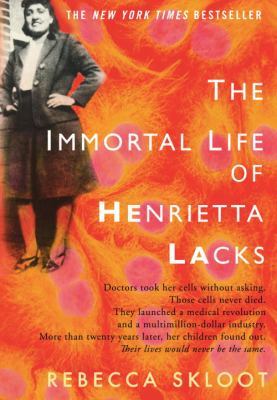
Review: The Immortal Life of Henrietta Lacks

Note: This post is part of my occasional series Books That Made a Difference.

source
It's not often that I call a book mind-blowing. But this one fits the bill.

It tells the incredible true story of (you guessed it) Henrietta Lacks, a Black woman who lived in Maryland in the 1950s. She developed cervical cancer and was treated at Johns Hopkins Hospital in Baltimore. During a surgery to treat the cancer, a doctor took—without her knowledge (and therefore, of course, without her consent)—some of her cervical cells, both of the cancerous and the non-cancerous varieties.

The cancerous cells turned out to be just what that doctor had been looking for: human cells that would stay "alive" and reproduce...so they could be used in scientific research. (The very nature of cancerous cells is that they reproduce out of control...yet they were still living human cells. Both of these things together made the cells a perfect growth medium.)

I mention her race above because back then, Johns Hopkins performed experiments on Black people, sometimes (clearly) without even their knowledge...which the book discusses.

Anyway, that doctor began to distribute and later even to sell Ms. Lacks' cells; however, for many years, Ms. Lacks' family was completely unaware that this was happening, and they certainly were not receiving any compensation for it.

Ms. Lacks' cells are still in use today and have been involved in a huge number of medical and other scientific breakthroughs. Much of the modern medicine and technology that we rely on today we owe in part to Ms. Lacks' cells.

In the book Rebecca Skloot tells not only the story of what happened to Ms. Lacks and her family but also the story of her investigation, which is also fascinating.

HBO made a movie (by the same name) based on the book, starring Oprah Winfrey and Rose Byrne. You can stream it online using HBO Now. If you don't already have HBO, you can stream it for free by signing up for a free 30-day trial first.

So...to sum up my review: This is, as I've said, an incredible true story, well told; I highly recommend it for everyone and think it should be required reading for all medical students as well as all other scientists.

Things That (Can) Help Depression

Photo by it's me neosiam from Pexels
Yesterday Cameron Kasky (one of the organizers of the March For Our Lives) tweeted that he hasn't been as active lately because he's been "struggling with depression and anxiety in a stronger form than [he's] ever seen it." I responded supportively, including saying that I know firsthand how debilitating depression can be. @Jennife42049695 replied and asked if I had any advice for managing depression.

I thought long and hard before replying. Because...I still live with depression. It's not like I've conquered it or anything. But today during my lunch hour, I sat down to write a careful reply.

Also, as it turns out...today is World Mental Health Day. I'd already thought about sharing my reply here; once I learned what today was, I knew I had to.

So...here's (an edited version of) what I told Jennifer, in case it's helpful to anyone listening in:

As you may know, depression generally isn't like: get depressed, do X to fix it, and then everything’s better. It doesn't tend to work like that.

Having said that, there are some things I suggest, because I find them helpful (not necessarily in this order):

  1. Figure out who in your life can and will—and who can’t or won’t—be able to handle hearing your pain, will hold space for it, and will give you empathy. Then when you share (if you share), do it only with the former.
     
  2.  Find community with others who are living the "same" experience. It can be incredibly validating to hear others say “me too!” When I've felt the need to, I've attended a Depression and Bipolar Alliance support group.
     
  3. Refuse to beat yourself up for resting when you’re too exhausted to do anything. If you don’t have the energy, you don’t have the energy—period. That does not mean you’re lazy.
     
  4. If you're able to, get medical advice. If you have to start with a general practitioner, be sure to ask for a referral to a specialist. (Most general practitioners aren’t taught much about psychology.) There's zero shame in taking medication for depression. And don't let anyone tell you otherwise. If it helps balance the chemistry in your brain and makes you feel better, then—it helps, period.
     
  5. Find an integrative medicine doctor (separate from #4), get an integrative health consult, and do as many of the things they suggest as possible.
     
  6. Related to #5: Try as many “alternative” things as possible until you figure out what helps you. Even if you're skeptical about them. As long as you believe you'll remain safe, there's generally no harm in trying them. I’m talking about things like yoga, massage, acupuncture, reiki, meditation, etc. I believe all of those have helped me at least a little. And—I’m still trying things.
     
  7. If you haven't already, figure out what kind(s) of music make you feel joyful, and listen to it when you're especially down (and even when you're not). This has a measurable health benefit.
     
  8. When you feel up to it, get out in nature and enjoy the beauty. This also has a measurable health (specifically mental health!) benefit. 

If you struggle with depression, what do you think of the things on my list? What helps you? Post a comment and let me know.
© A Road Less Traveled

This site uses cookies from Google to deliver its services - Click here for information.

Professional Blog Designs by pipdig